Table of Contents
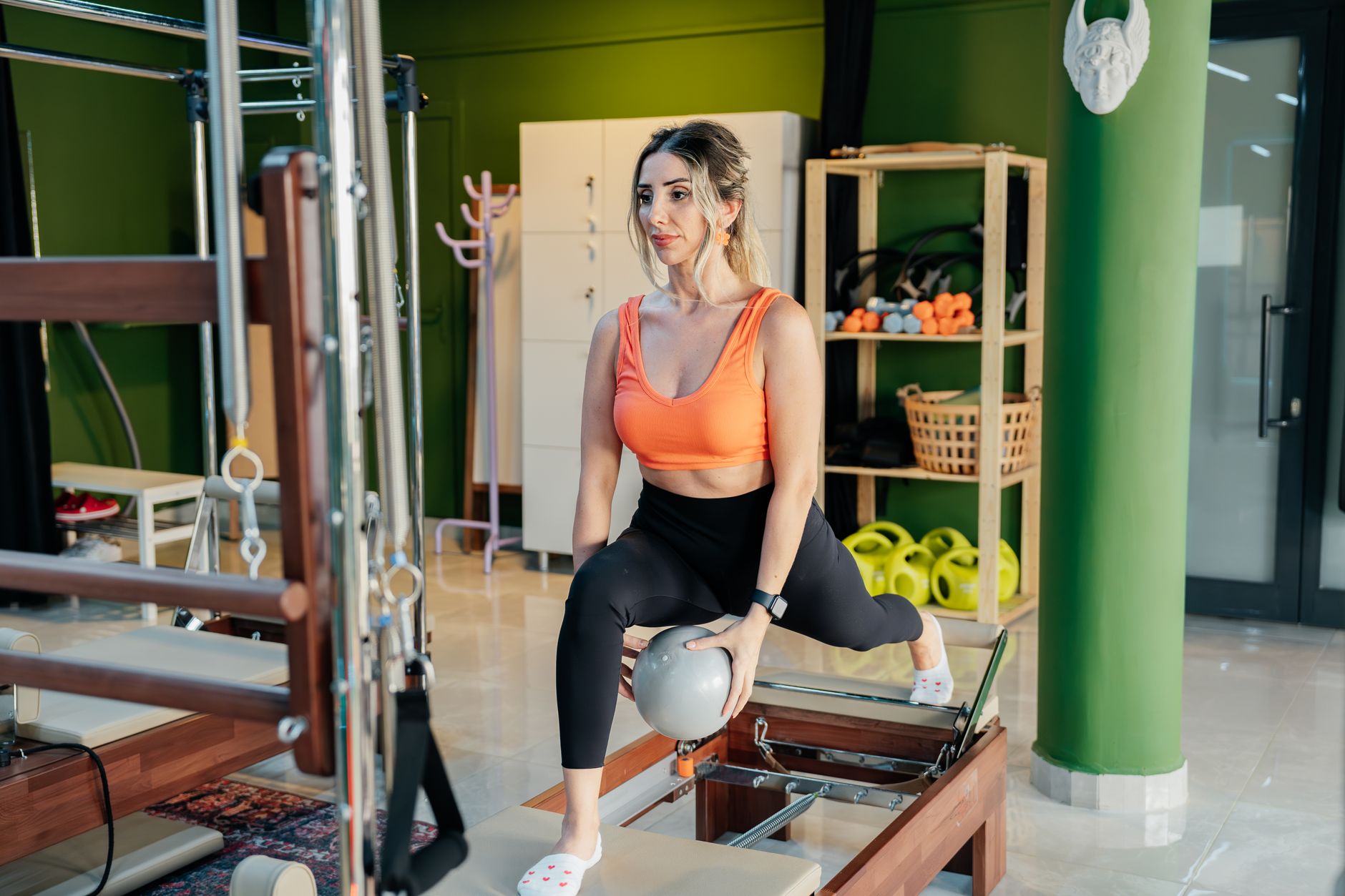
Mat Pilates bookings on ClassPass more than doubled last year. They rose 114%, according to the company’s 2025 Look Back report, which also crowned Pilates the most-booked workout in the world for the third year running. Reformer bookings grew too, by 71%, but the cheap version on the floor grew faster. I think a lot of women have quietly figured out something the boutique studios would rather not say out loud. Is reformer Pilates strength training? Yes, but the research gives the machine itself surprisingly little credit for that.
My take after digging through the studies: reformer Pilates absolutely counts toward your weekly strength work. But if you’re booking it twice a week at drop-in prices, you’re paying a premium the studies don’t back up, and you might be skipping the one kind of training that matters most for your bones later on.
Is reformer Pilates strength training? The research says yes, and it holds up against weights
Start with what the CDC asks of you. Adults need muscle-strengthening activity at least two days a week, working all the major muscle groups: legs, hips, back, abdomen, chest, shoulders and arms. It doesn’t say “lift barbells.” It says work the muscles hard enough that they’re challenged.
Pilates passes that test better than its reputation suggests. In a 2019 randomized trial published in PeerJ, researchers in Murcia, Spain split 60 women aged 60 to 80 into a Pilates group, a traditional resistance-training group and a control group, and trained them twice a week for 18 weeks. Isometric trunk extension strength rose 18.7% in the Pilates group and 22.2% in the resistance group, and the difference between the two wasn’t statistically significant. Hip extension strength went up 35.5% with Pilates.
A 2022 systematic review of 11 randomized trials reached a similar conclusion across dynamic, isometric and resistance strength: no difference between Pilates and other forms of exercise. The authors rated the evidence as very low to low certainty, so treat it as a strong hint and not a verdict, but the direction is consistent. If you’ve been feeling guilty that your Tuesday reformer class isn’t “real” strength training, you can let that go.
The reformer premium buys springs, not proven extra strength
I expected the machine to have the edge here, and it doesn’t, at least not on paper. If you go looking for head-to-head trials of mat versus reformer Pilates in healthy women, you mostly find small studies in clinical groups, like a 2017 trial in people with multiple sclerosis. Nobody has shown that the machine builds meaningfully more strength than a well-taught mat class for women like us.
Does the reformer have real advantages? Sure. The springs give you adjustable resistance and support, which is lovely if you’re coming back from an injury or you like the feeling of being guided through a movement. Plenty of people also simply enjoy it more, and if the reformer is the only thing that gets you out of bed at 6 a.m. in January, that has value. But “I like it” and “it’s the more effective strength workout” are different claims, and the price difference is charged as if they were the same.
That price difference is real. According to Mindbody platform data compiled by SchedulingKit and reported by bsport in June, the average US drop-in price is $32 for a reformer class and $18 for a mat class. In big cities, boutique reformer studios charge $35 to $55 a class.
Two reformer classes a week cost $3,328 a year, and one swap saves $728
The useful way to look at it is per guideline, since two days a week is the target you’re trying to hit.
Two reformer drop-ins a week at $32 is $64. Multiply by 52 weeks and you’re at $3,328 a year. Keep one reformer class and make the second one mat Pilates at $18, and the week costs $50, or $2,600 a year. That single swap saves you $728. Go mat for both days and you’re at $36 a week, $1,872 a year, which is $1,456 less than the all-reformer plan, for what the current research says is roughly the same strength stimulus.
Memberships change the numbers a little. Boutique reformer memberships typically run $159 to $230 a month, so if you’re going eight times a month on a $230 plan, you’re paying about $28.75 a class. Still well above the mat drop-in rate. And that’s before we talk about the Thursday you skipped because you were exhausted, which you paid for anyway.
You don’t have to quit the class you love. The second weekly session is where the money leaks, and that one doesn’t have to be on a machine.
What Pilates won’t do for your bones in your 40s and beyond
The strongest case for spending your second session differently has nothing to do with money. It’s bone.
Bone responds to heavy loading, and most Pilates work, on a mat or a machine, stays in moderate territory. The best-known evidence here is the LIFTMOR trial out of Griffith University, published in 2017 in the Journal of Bone and Mineral Research. It put 101 postmenopausal women with low bone mass on either a supervised high-intensity lifting program (just two 30-minute sessions a week, for eight months) or a low-intensity home routine. Only 18.6% of the lifting group lost bone density at the lumbar spine, compared with 72.1% of the low-intensity group. These women were 58 and older, so it’s not a perfect match for a 38-year-old reader, but it tells you what kind of stimulus bone answers to.
If you’re in your late 30s or 40s and perimenopause is already on your radar (our guide to perimenopause symptoms and hormones covers why), this is the decade when building the habit of loading your skeleton pays off. A smart split might be one reformer class you love plus one session of progressively heavier squats, deadlifts and presses, whether that’s in a gym, a strength class or your garage. If you have osteoporosis, osteopenia, or any joint or back issue, talk to your doctor or a physical therapist before you start heavy lifting, since the right load really does depend on you.
Plenty of women are already making this shift. Strength training was ClassPass’s third most-booked workout in 2025, with bookings up 27%.
Keep the class you love, and spend the second day differently
So, is reformer Pilates strength training? It is, it counts toward your two days, and you should keep doing it if it makes you happy and gets you out the door. Just don’t let the price tag convince you that the machine is doing something magic. Make one of your weekly sessions mat Pilates or real lifting, pocket the $728, and give your bones the heavier work they’ll thank you for in twenty years. And if you like slower, more meditative movement on your off days, our guide to Ashtanga yoga is a good place to start.

Allie Wright
Allie Wright is an seasoned writer and the main content creator for Ask Her First. She uses her platform to inspire, educate, and uplift people from all walks of life. Allie's writing is a reflection of her deep commitment to celebrating womanhood in all its forms, and she is dedicated to exploring topics that resonate with her readers, from fashion and beauty to health, wellness, and personal growth. Allie's passion for writing is matched only by her love for creativity and expression. In her free time, she can often be found with a paintbrush in hand, lost in the vibrant world of her canvases. She is also an avid reader, always on the hunt for the next captivating novel to broaden her horizons and spark her imagination.
More stories by this author