Table of Contents
In 2018, German researchers handed 52 adults a stack of jigsaw puzzles and asked them to work on them at home for at least an hour a day, 30 days out of five weeks. Together the group snapped in an average of 3,589 pieces per person over 49 hours. Then the researchers tested their visuospatial thinking (the mental skill of seeing how shapes fit and rotate) against a control group that hadn’t touched a puzzle. The puzzlers did no better.
I love that study, and not because I want to ruin anyone’s hobby. Most lists of the benefits of jigsaw puzzles lead with memory, IQ, and dopamine, and the best experiment we have doesn’t back those up. What the study does tell you is how long a puzzle lasts. That number, it turns out, is the strongest argument for putting a 1,000-piece box on the table at Thanksgiving.
The best trial on jigsaw puzzles found no brain boost
The study, published in Frontiers in Aging Neuroscience by Patrick Fissler and colleagues, enrolled 100 cognitively healthy adults aged 50 and up. Both groups got four sessions of cognitive health counseling, and the puzzle group got the puzzles too. When the five weeks were over, both groups had improved a little on the combined visuospatial score, but the puzzlers hadn’t improved any more than the counseling-only group. The statistical effect was essentially zero. The one thing that clearly got better was the puzzlers’ skill at doing a new jigsaw puzzle.
The same paper did find something interesting before the experiment began. People who reported more lifetime puzzling scored higher on visuospatial tests at baseline, even after the researchers adjusted for other risk and protective factors. The authors are careful here, and so should we be: that link isn’t necessarily causal. People who are good at seeing shapes may simply enjoy puzzles more.
So when you see a Pinterest graphic promising that puzzles “improve short-term memory,” the honest answer is that a five-week, 49-hour dose didn’t move the needle in a controlled trial.
The long-term research says stay mentally busy, not “do puzzles”
There’s a bigger body of research behind the brain-health claims, and it’s worth reading closely. In 2021, Rush University researchers published a study in Neurology that followed 1,903 older adults, average age about 80, for roughly seven years. Participants rated how often they did seven mentally engaging activities, including reading, writing letters, and playing games like checkers, board games, and puzzles. According to Rush’s summary, the most cognitively active group developed Alzheimer’s dementia at about age 94 on average, compared with about 89 for the least active group.
That’s a striking gap. It’s also an association built on self-reported habits, in a mostly white group of older Chicago-area volunteers, and puzzles were one item among seven. Read honestly, it says a mentally busy life tracks with later dementia onset. It doesn’t single out the jigsaw. If brain health is your main goal, the question to bring to your doctor is how to stay mentally and socially active overall, not which puzzle to buy.
I’d take that as permission rather than disappointment. You don’t need to justify a puzzle as medicine.
A 1,000-piece puzzle is about 14 hours of table time
Here’s the part of the 2018 study nobody quotes. Those 52 puzzlers worked at a real-world pace: 3,589 pieces in 49 hours, or about 73 pieces an hour. These weren’t speed puzzlers on a stopwatch. They were ordinary adults over 50 doing puzzles at their kitchen tables.
At that pace, a 1,000-piece puzzle takes about 13.7 hours. Spread across a four-day Thanksgiving weekend, from Thursday morning to Sunday afternoon, that’s roughly three and a half hours of puzzle time a day. In my family, that’s about the amount of time people spend drifting between the coffee pot, the football game, and the dishes anyway.
The price is just as concrete. The Ravensburger Bizarre Bookshop 1,000-piece puzzle is $20.99 at Target online right now. Divide $20.99 by 13.7 hours and you’re paying about $1.53 per hour of puzzle time, for whoever happens to be sitting at the table.
Compare that with the default family outing for that weekend. Reuters reported in August that the average adult movie ticket in 2026 has been $13.46, according to EntTelligence. Four adults at a two-hour movie spend $53.84 for 2 hours, or about $26.92 an hour, before popcorn. The puzzle costs less than half of those four tickets and lasts almost seven times as long. And unlike the movie, people can drift in and out of it without paying again.
The real benefits of jigsaw puzzles are social
Once you stop asking the puzzle to fix your memory, you can ask it to do the job it’s good at, which is giving a crowded house somewhere to land.
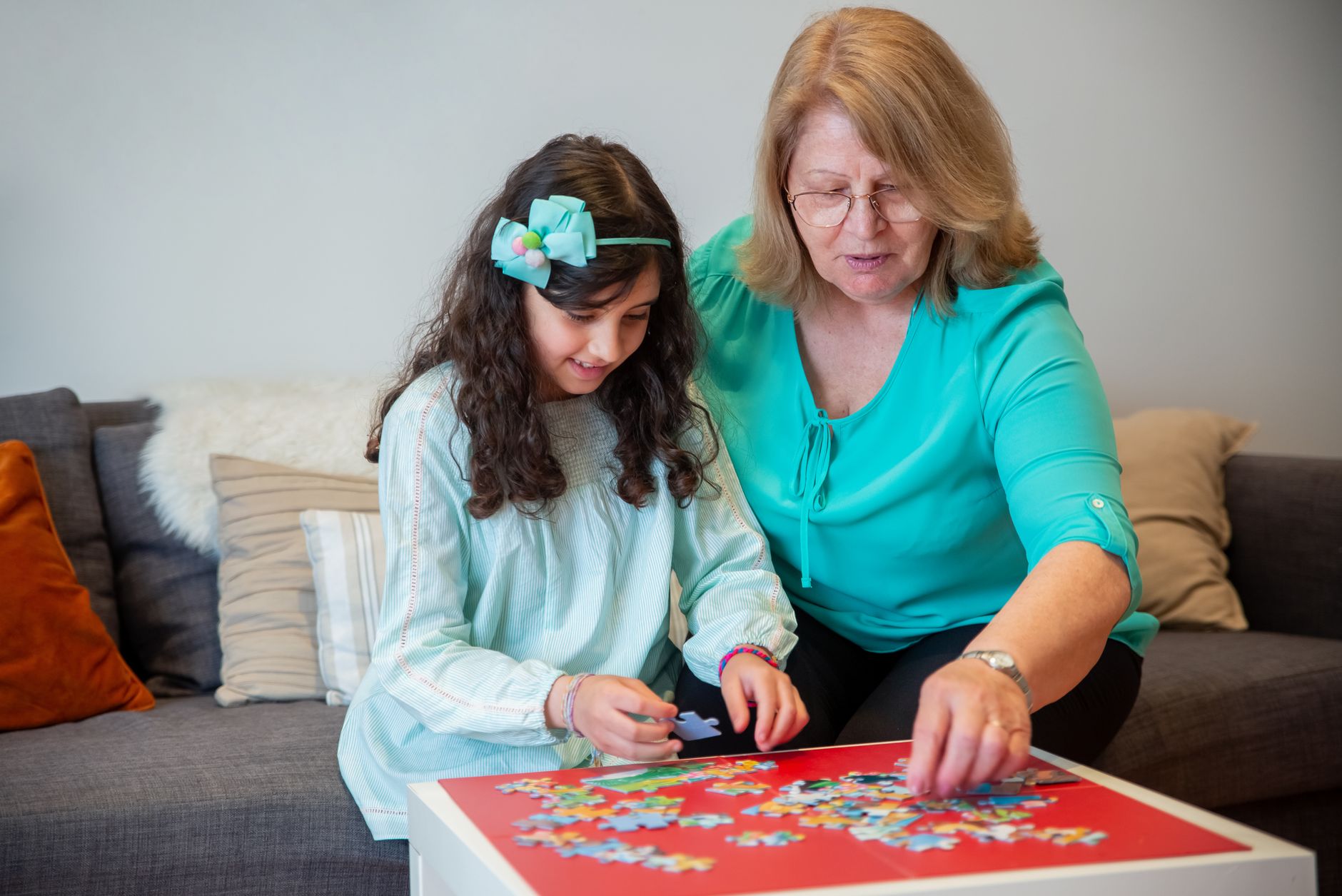
A puzzle gives everyone something to do with their hands and eyes that isn’t a phone or a television, and it doesn’t require eye contact. I find side-by-side time far easier than face-to-face small talk, especially with relatives I see twice a year. Your teenage nephew who won’t answer “how’s school” will happily tell you the sky pieces are all in the wrong pile. Your aunt who gets heated about the news can sort edge pieces for an hour without anyone raising their voice. If you read our piece on talking politics at Thanksgiving, think of the puzzle table as the exit ramp: a place anyone can step into when the conversation at dinner needs a break.
Plenty of grown-ups seem to want the same thing. Circana data through June 2026, as reported by eMarketer, shows toy sales for adults 18 and older grew 25% year over year, and a puzzle is about the least intimidating toy an adult can buy.
How to pick a puzzle that actually gets finished
The worst outcome is a puzzle that sits half done on your dining table until mid-December, so choose for the weekend you have.
For a crowd of mixed ages and skill levels, 1,000 pieces is the right size, but the image matters more than the count. Pick a picture with lots of distinct zones (a bookshop, a busy street, a collage of objects) so that several people can each claim a section. Avoid big areas of one color. A sky, an ocean, or a snowfield can stretch a 14-hour puzzle well past the weekend and leaves the kids with nothing to do.
Set it up on a card table or a spare board somewhere off the main path. Thanksgiving tables get reclaimed for dinner, and moving a half-finished puzzle is how pieces end up under the couch. If you’re short on space, a large piece of foam board works as a portable surface you can slide onto a bed.
Start it on Thursday morning, not Saturday. At about 14 hours, it needs the whole weekend, and an early start means it can be finished by the time people leave. If it isn’t, that’s a reason to invite someone back to finish it, which is a pretty good outcome too. And if you’re looking for a quiet hobby after the holidays, this pairs well with the beginner knitting project we covered earlier this month.
The benefits of jigsaw puzzles are smaller and more ordinary than the internet claims. They won’t rewire your brain in five weeks. What they will do is give a crowded house about 14 hours of something to do together for about $21, and I’ll take that deal every November.

Allie Wright
Allie Wright is an seasoned writer and the main content creator for Ask Her First. She uses her platform to inspire, educate, and uplift people from all walks of life. Allie's writing is a reflection of her deep commitment to celebrating womanhood in all its forms, and she is dedicated to exploring topics that resonate with her readers, from fashion and beauty to health, wellness, and personal growth. Allie's passion for writing is matched only by her love for creativity and expression. In her free time, she can often be found with a paintbrush in hand, lost in the vibrant world of her canvases. She is also an avid reader, always on the hunt for the next captivating novel to broaden her horizons and spark her imagination.
More stories by this author