Table of Contents
In a 2010 lab study, volunteers who rinsed norovirus off their fingertips with nothing but tap water removed more of it than volunteers who used an alcohol hand sanitizer. Not a fancy soap. Water. If you’ve ever typed “does hand sanitizer kill norovirus” into a search bar, that result is the short answer, and it matters right now: the CDC says norovirus outbreaks are most common from November to April, which means stomach bug season and holiday hosting season are the same season.
Every article on this topic stops at “wash your hands instead.” I agree with that, but I think it misses the second half of the problem. Most of us lose to norovirus twice: once at the pump bottle by the door, and again at the kitchen counter, where we spray a disinfectant and wipe it dry in about fifteen seconds. The label on that spray is asking for ten minutes. My argument is that your defense this winter has very little to do with which products you buy and almost everything to do with a sink and a timer.
Does hand sanitizer kill norovirus? Barely, because there’s no envelope to dissolve
Alcohol works by dissolving the fatty outer envelope that viruses like flu and COVID wrap themselves in. Norovirus doesn’t have one. It’s a tough little protein shell, which is why it can survive on a doorknob or a serving spoon long enough to ruin a whole family’s weekend.
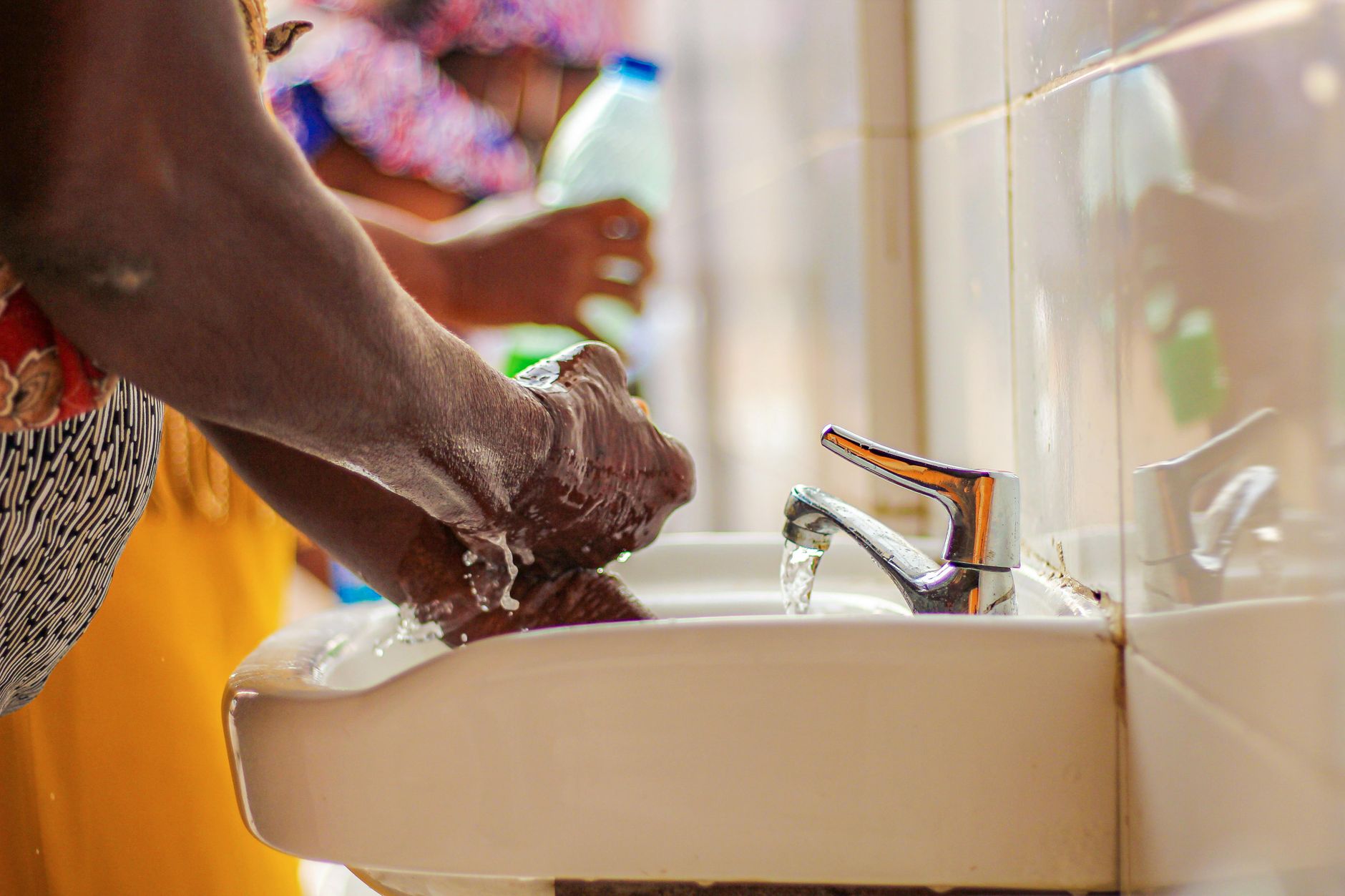
The CDC’s own norovirus prevention page is blunt about it: hand sanitizer alone does not work well against norovirus. The agency says to wash with soap and water for at least 20 seconds, especially after using the bathroom, before eating or touching food, and before giving anyone medicine. Sanitizer can be an extra step, not a replacement.
The numbers behind that advice come from the 2010 study in Applied and Environmental Microbiology I opened with. Researchers put Norwalk virus (the original norovirus strain) on volunteers’ finger pads and measured how much was left after each method. Antibacterial liquid soap cut it by 0.67 to 1.20 logs. A plain water rinse cut it by 0.58 to 1.58 logs. The alcohol sanitizer managed only 0.14 to 0.34 logs. One honest caveat: the researchers counted viral genetic material, so the study measures how much virus got removed, not how much was killed. Soap and water win precisely because they physically carry the virus down the drain, and that’s the part sanitizer can’t do.
Running the numbers on hand sanitizer vs soap for norovirus
“Logs” are hard to picture, so let’s turn them into something you can see. Imagine your hands are carrying 1,000 virus particles after you help a sick kid or change a bed.
A log reduction of 0.34, the best result for sanitizer, leaves 10 to the power of negative 0.34 of the original amount, which is about 45.7%. So the best sanitizer case leaves around 457 of your 1,000 particles. The worst sanitizer case, 0.14 logs, leaves about 72.4%, or 724 particles.
Soap and water at 1.20 logs leaves about 6.3%, so 63 particles. At 0.67 logs it leaves about 21.4%, or 214. Compare best to best and worst to worst: 457 divided by 63 is about 7.3, and 724 divided by 214 is about 3.4. Even in the kindest version of this math, the hands you sanitized are carrying three to seven times more norovirus than the hands you washed.
That gap matters more for norovirus than for almost any other bug. The CDC estimates norovirus causes 19 to 21 million illnesses in the US every year, along with 109,000 hospitalizations and about 900 deaths, mostly in adults 65 and older. If your Thanksgiving table includes a grandparent, three to seven times more virus on the hands that carve the turkey is not a small difference.
Your disinfectant spray needs 10 minutes, not 10 seconds
The EPA keeps a list of products it has verified against norovirus, called List G, and every entry has a contact time: how long the surface has to stay wet for the product to work.
The times are longer than I expected. Lysol Disinfectant Max Cover Mist is listed at 10 minutes against norovirus. Lysol’s All Purpose Cleaner, also 10 minutes. Clorox Regular Bleach and Clorox Clean Up Cleaner + Bleach are listed at 5 minutes, and Clorox Total 360 at 2. If you spray a counter and wipe it 15 seconds later, which is how most of us clean, you’ve given a 10-minute product 2.5% of the time it needs (15 seconds out of 600). At that point the paper towel is mostly relocating the virus.
The CDC’s cleanup guidance lines up with this. After someone gets sick, it recommends a chlorine bleach solution of 1,000 to 5,000 ppm, which works out to 5 to 25 tablespoons of household bleach (the 5% to 8% kind) per gallon of water, or an EPA-registered product that claims norovirus on its label. Leave it on for at least 5 minutes, then clean the area again with soap and hot water. Wear gloves, use paper towels, and bag them. For the record, 25 tablespoons is just over a cup and a half, and 5 tablespoons is a little less than a third of a cup.
The habit I’d steal: spray, set a phone timer for whatever your label says, walk away, then wipe. Before you buy anything new, read the back of what’s already under your sink and look for “norovirus” in the disinfection directions. The EPA says that line is what makes a product’s norovirus claim count.
Why the sick person stays out of the kitchen for 48 hours
Norovirus is contagious before symptoms show up and, according to the CDC, can stay in stool for two weeks or more after you feel better. That’s why the agency says anyone who’s been sick shouldn’t prepare food or care for other people until at least 48 hours after symptoms stop.
I know how that lands in late November. Someone has been planning the stuffing for weeks, and two days of rest feels like an overreaction once they’re keeping toast down. But the CDC also says norovirus causes 58% of the foodborne illness people pick up in the US, and a holiday kitchen is a very efficient way to share it. If the person who was sick on Monday is the person making the pie on Thursday, check the math on the calendar before anyone touches a rolling pin. If it’s under 48 hours, someone else cooks. (And if you’re hosting, our oven timing guide is a good reminder that holiday prep runs on the calendar anyway.)
Laundry matters too. The CDC says to pull soiled sheets right away, handle them without shaking, wash on hot with the longest cycle, and dry on the highest heat.
The season is just starting, so set up the sink now
As of the CDC’s latest NoroSTAT update, participating states reported 62 norovirus outbreaks between August 1 and October 9, 2026, compared with 70 in the same stretch last year, which puts this season in a normal range so far. Normal still means a long winter. WastewaterSCAN data showed last season’s levels starting to climb in early October and peaking in early February.
So, does hand sanitizer kill norovirus? Not reliably, and it removes far less of it than water does. Keep your sanitizer for the car and the grocery cart, where there’s no sink. At home, put a pump of soap at every sink, put a note on the cleaning caddy with your spray’s contact time, and treat a 48-hour waiting rule as part of the holiday plan rather than a buzzkill. None of this costs money. It costs about ten minutes of patience, which beats a couple of days on the bathroom floor. If you’re in a higher-risk group or symptoms get serious (signs of dehydration especially), call your doctor. And if you’re overdue for one, this is a good season to book the annual checkup you’ve been putting off.

Allie Wright
Allie Wright is an seasoned writer and the main content creator for Ask Her First. She uses her platform to inspire, educate, and uplift people from all walks of life. Allie's writing is a reflection of her deep commitment to celebrating womanhood in all its forms, and she is dedicated to exploring topics that resonate with her readers, from fashion and beauty to health, wellness, and personal growth. Allie's passion for writing is matched only by her love for creativity and expression. In her free time, she can often be found with a paintbrush in hand, lost in the vibrant world of her canvases. She is also an avid reader, always on the hunt for the next captivating novel to broaden her horizons and spark her imagination.
More stories by this author